ECB Signals September Hike Incoming
Hawkish Hold From ECB
Yesterday’s July ECB meeting saw the bank delivering a firmly hawkish hold, though this proved to be little help for EUR which fell sharply against the Dollar over the day. The central message from the meeting was that the re-escalation of the Iran war has reignited inflation fears in the eurozone as a result of the renewed surge in energy prices over recent weeks. As such, a follow-up hike in Autumn is firmly on the table for the bank as it monitors incoming data ahead and geopolitical developments ahead of that time. with the statement noting: "Uncertainty remains high and the full inflationary impact of the energy shock has yet to play out. The Governing Council is therefore closely monitoring the intensity and duration of the shock, as well as its indirect and second-round effects."
September Hike Forecast
September is now seen as the preferred option for a follow-up hike to June’s move. Following that hike, ECB chief Lagarde was keen to stress that the hike was not an insurance move but a considered response to a genuine inflation problem, while the signalling the likely need for further tightening. As such, traders have kept ECB tightening expectations in focus in recent weeks though with this month’s meeting not a forecasting update, September was seen as the stronger choice for a further hike.
Hawkish Fed Expectations
Despite this guidance, EURUSD remains under pressure. This largely reflects the return of hawkish Fed expectations also amidst the upsurge in oil prices. Market pricing for a Fed rate hike this year had fallen across June and early July as a result of tanking oil prices. However, with crude now fast approaching $100 p/b again, tightening expectations are rising once again.
Technical Views
EURUSD
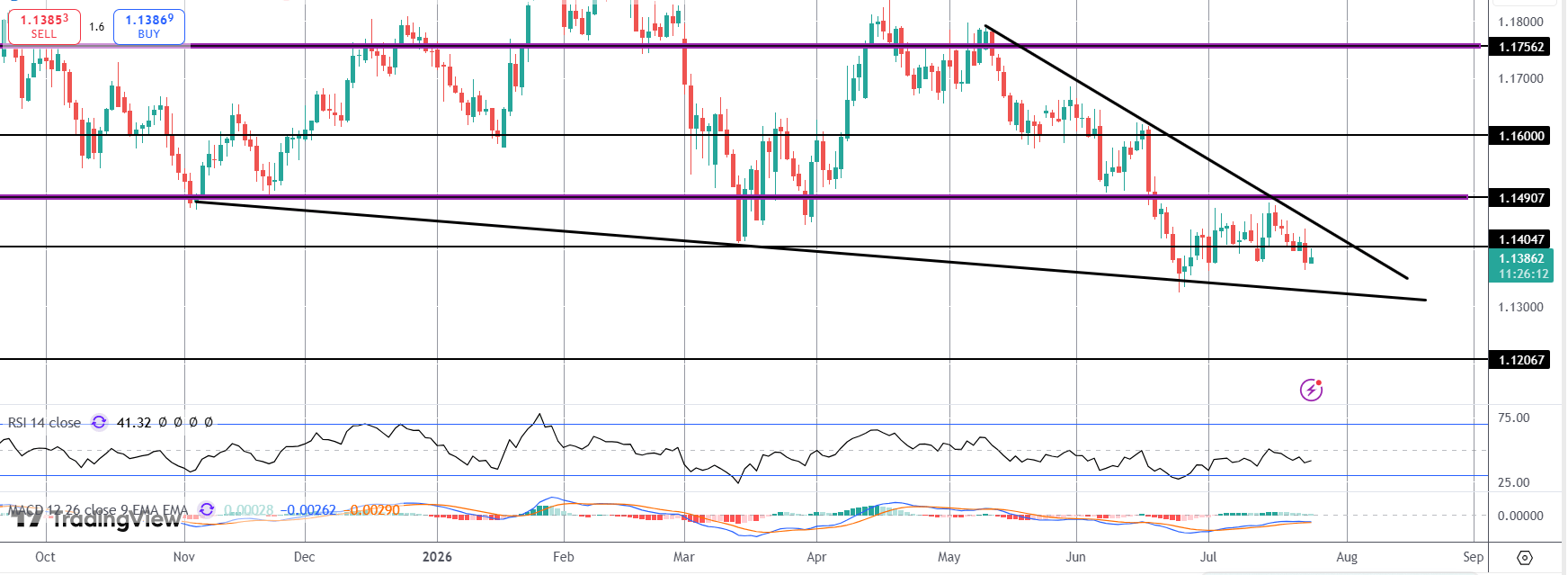
The market has turned back below the 1.1404 level and is fighting to stay above the YTD lows around 1.1329. Momentum studies are turning lower again here suggesting risks of a deeper push down towards the 1.1206 level next. Topside, bulls need to clear 1.1490 to alleviate bearish risks.
Disclaimer: The material provided is for information purposes only and should not be considered as investment advice. The views, information, or opinions expressed in the text belong solely to the author, and not to the author’s employer, organization, committee or other group or individual or company.
Past performance is not indicative of future results.
High Risk Warning: CFDs are complex instruments and come with a high risk of losing money rapidly due to leverage. 68% and 74% of retail investor accounts lose money when trading CFDs with Tickmill UK Ltd and Tickmill Europe Ltd respectively. You should consider whether you understand how CFDs work and whether you can afford to take the high risk of losing your money.
Futures and Options: Trading futures and options on margin carries a high degree of risk and may result in losses exceeding your initial investment. These products are not suitable for all investors. Ensure you fully understand the risks and take appropriate care to manage your risk.
With 10 years of experience as a private trader and professional market analyst under his belt, James has carved out an impressive industry reputation. Able to both dissect and explain the key fundamental developments in the market, he communicates their importance and relevance in a succinct and straight forward manner.